
Quick Answers
Here’s what sellers most often ask about Related Accounts.
What’s a realistic timeline for Related Accounts?
Is professional help worth it here?
Every seller’s situation is different, so treat Related Accounts as a starting point and match your response to the exact wording Amazon used in your case.
One thing sellers underestimate about Related Accounts: timing your response matters almost as much as the content of it.
Keep a dated log of every action you take and every message you send — if a case escalates, that record becomes your strongest asset.
The core principle behind Related Accounts applies broadly, but the details of your response should match your exact notice.
For Related Accounts, a clear paper trail of dates and communications makes any necessary escalation much smoother.
For Related Accounts, a clear paper trail of dates and communications makes any necessary escalation much smoother.
Related Accounts tends to go smoother when you separate what Amazon is asking for from what you assume they’re asking for.
Related Accounts tends to go smoother when you separate what Amazon is asking for from what you assume they’re asking for.
For sellers dealing with Related Accounts for the first time, the learning curve is steep mainly because the terminology overlaps with several other Amazon processes. It helps to separate what happened from why it happened — a timeline of events paired with the specific corrective steps taken tends to read as more credible than a general apology. Timelines quoted by other sellers online are not guarantees — plan for the process to take longer than expected.
Understanding Related Accounts properly means looking past the surface-level advice and focusing on what Amazon’s investigation teams are actually trained to check. A response that only addresses the single flagged order, without showing what changed operationally, tends to get treated as insufficient even when the facts are accurate. Consistency between what is claimed in the appeal and what is visible in the account’s actual order history matters more than polished language.
The way Amazon handles Related Accounts has shifted over the past few review cycles, and older forum advice can now be misleading. Sellers who organize their evidence into labeled sections — background, cause, correction, prevention — make it easier for a reviewer to confirm compliance without follow-up questions. Every account’s history is different, so treat general guidance as a starting point rather than a guaranteed template.
When it comes to Related Accounts, sellers frequently underestimate how much documentation Amazon expects before a case is even reviewed. Reviewers typically look for a clear root-cause explanation, supporting evidence such as invoices or shipping records, and a forward-looking plan that shows the same issue will not recur. Getting a second pair of eyes on the draft before submission catches gaps that are easy to miss after reading a notice repeatedly.
Many sellers reach out about Related Accounts only after their first attempt has already been rejected, which makes the second attempt far more important to get right. Account health metrics from the 60 to 90 days before the issue are usually part of the picture review
Related Accounts Amazon: How Linking Happens
Related accounts Amazon flags arise when Amazon associates two seller accounts through shared sign-in details — IP address, device fingerprint, banking details, business identity, or address data. Linking can happen even when the two accounts belong to different people who happen to share a device or a workspace.
Related accounts Amazon cases are hard to appeal because the notice rarely says which detail triggered the link. The plan of action must address every shared detail you can identify, explain why it was shared, and show what changed so it will not happen again.
Do not open a new account after a related accounts Amazon suspension. A new account that shares any detail with the suspended one will be linked again, and the second link is treated as evasion.
Related reading: see compare every Amazon violation type and what to do after an appeal is rejected for more on related accounts Amazon.
For the official rules on related accounts Amazon, see Amazon Seller Central.
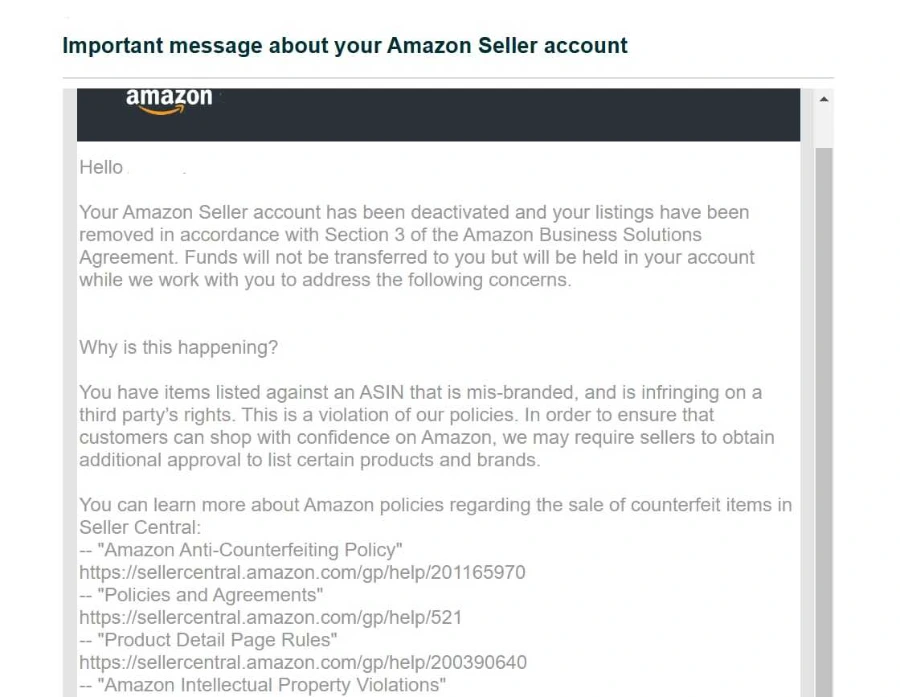
A well-prepared response to Related Accounts issues usually shares a few traits: it is specific, dated, and tied directly to the policy language cited. Cases that reference the exact policy clause, include dated screenshots, and avoid vague language about ‘improving processes’ are processed noticeably faster in most reported experiences. If the case involves multiple linked issues, it is usually worth addressing them together rather than filing separate appeals.
Related accounts Amazon: how Amazon links seller accounts through shared details, and what to do when a related account triggers a suspension.
Related Accounts
A related or linked account is one Amazon associates with another seller account through shared signals — IP address, device fingerprint, banking details, business identity, or address data. Linking can happen even when the seller was unaware the other account existed.
Read the full related accounts guide
Quick Answers
Here’s what sellers most often ask about Related Accounts.
What’s a realistic timeline for Related Accounts?
Is professional help worth it here?
Every seller’s situation is different, so treat Related Accounts as a starting point and match your response to the exact wording Amazon used in your case.
One thing sellers underestimate about Related Accounts: timing your response matters almost as much as the content of it.
Keep a dated log of every action you take and every message you send — if a case escalates, that record becomes your strongest asset.
The core principle behind Related Accounts applies broadly, but the details of your response should match your exact notice.
For Related Accounts, a clear paper trail of dates and communications makes any necessary escalation much smoother.
For Related Accounts, a clear paper trail of dates and communications makes any necessary escalation much smoother.
Related Accounts tends to go smoother when you separate what Amazon is asking for from what you assume they’re asking for.
Related Accounts tends to go smoother when you separate what Amazon is asking for from what you assume they’re asking for.
For sellers dealing with Related Accounts for the first time, the learning curve is steep mainly because the terminology overlaps with several other Amazon processes. It helps to separate what happened from why it happened — a timeline of events paired with the specific corrective steps taken tends to read as more credible than a general apology. Timelines quoted by other sellers online are not guarantees — plan for the process to take longer than expected.
Understanding Related Accounts properly means looking past the surface-level advice and focusing on what Amazon’s investigation teams are actually trained to check. A response that only addresses the single flagged order, without showing what changed operationally, tends to get treated as insufficient even when the facts are accurate. Consistency between what is claimed in the appeal and what is visible in the account’s actual order history matters more than polished language.
The way Amazon handles Related Accounts has shifted over the past few review cycles, and older forum advice can now be misleading. Sellers who organize their evidence into labeled sections — background, cause, correction, prevention — make it easier for a reviewer to confirm compliance without follow-up questions. Every account’s history is different, so treat general guidance as a starting point rather than a guaranteed template.
When it comes to Related Accounts, sellers frequently underestimate how much documentation Amazon expects before a case is even reviewed. Reviewers typically look for a clear root-cause explanation, supporting evidence such as invoices or shipping records, and a forward-looking plan that shows the same issue will not recur. Getting a second pair of eyes on the draft before submission catches gaps that are easy to miss after reading a notice repeatedly.
Many sellers reach out about Related Accounts only after their first attempt has already been rejected, which makes the second attempt far more important to get right. Account health metrics from the 60 to 90 days before the issue are usually part of the picture review
Related Accounts Amazon: How Linking Happens
Related accounts Amazon flags arise when Amazon associates two seller accounts through shared sign-in details — IP address, device fingerprint, banking details, business identity, or address data. Linking can happen even when the two accounts belong to different people who happen to share a device or a workspace.
Related accounts Amazon cases are hard to appeal because the notice rarely says which detail triggered the link. The plan of action must address every shared detail you can identify, explain why it was shared, and show what changed so it will not happen again.
Do not open a new account after a related accounts Amazon suspension. A new account that shares any detail with the suspended one will be linked again, and the second link is treated as evasion.
Related reading: see compare every Amazon violation type and what to do after an appeal is rejected for more on related accounts Amazon.
For the official rules on related accounts Amazon, see Amazon Seller Central.
A well-prepared response to Related Accounts issues usually shares a few traits: it is specific, dated, and tied directly to the policy language cited. Cases that reference the exact policy clause, include dated screenshots, and avoid vague language about ‘improving processes’ are processed noticeably faster in most reported experiences. If the case involves multiple linked issues, it is usually worth addressing them together rather than filing separate appeals.