
Appeals & Templates
- Amazon Plan of Action Sample: Full Example You Can Adapt
- Amazon Plan of Action for Late Shipment Rate: A Real Example
- Amazon Suspension Appeal Letter: Template & Guide
- Amazon Suspension Appeal Service
- Your Amazon Appeal Was Rejected — What Now
- The Amazon Plan of Action Structure
- Should You Appeal Your Amazon Suspension Yourself?
- Plan of Action (POA)
With Appeals & Templates, the sellers who move fastest are the ones who read the notice line by line before drafting anything.
Keep numbers and dates consistent across every document you submit — small mismatches are one of the most common reasons for a second request.
A rushed submission is rarely faster in the end — most delays come from having to correct or resubmit.
With Appeals & Templates, the sellers who move fastest are the ones who read the notice line by line before drafting anything.
Keep numbers and dates consistent across every document you submit — small mismatches are one of the most common reasons for a second request.
A rushed submission is rarely faster in the end — most delays come from having to correct or resubmit.
Appeals & Templates is one of those areas where the difference between a fast resolution and a stalled account often comes down to preparation, not luck. Keeping a running log of supplier communications, tracking numbers, and internal QC checks makes future submissions faster since the evidence is already organized. Escalation paths exist for cases that stall, but they work best after a complete, well-documented first submission rather than as a shortcut.
Appeals & Templates sits at the intersection of policy compliance and operational history, so a single missing data point can change how a case is read. Where third-party suppliers or freight partners are involved, naming them directly along with dates and order numbers reduces the chance of the case being read as incomplete. None of this replaces reading the specific notice Amazon sent, since wording and required evidence can vary case by case.
For sellers dealing with Appeals & Templates for the first time, the learning curve is steep mainly because the terminology overlaps with several other Amazon processes. It helps to separate what happened from why it happened — a timeline of events paired with the specific corrective steps taken tends to read as more credible than a general apology. Timelines quoted by other sellers online are not guarantees — plan for the process to take longer than expected.
Understanding Appeals & Templates properly means looking past the surface-level advice and focusing on what Amazon’s investigation teams are actually trained to check. A response that only addresses the single flagged order, without showing what changed operationally, tends to get treated as insufficient even when the facts are accurate. Consistency between what is claimed in the appeal and what is visible in the account’s actual order history matters more than polished language.
The way Amazon handles Appeals & Templates has shifted over the past few review cycles, and older forum advice can now be misleading. S
Appeals Templates: How to Use Them Well
A template is a starting point, not a finished appeal. Copy the structure, then replace every placeholder with your own facts — the exact notice wording, the ASIN, the order IDs, the dates, and the evidence you actually have.
The most common mistake with templates is submitting them nearly unchanged. Reviewers see the same wording hundreds of times. An appeal that reads like your case — in your own words, with your own evidence — is the one that gets read.
Frequently Asked Questions
Should I use a template or write my appeal from scratch?
Use a template for the structure, then rewrite the content with your own facts. The template keeps the appeal organised; your facts make it credible.
Can I submit the same appeal twice?
No. Resubmitting the same text usually fails. If the first appeal was rejected, read the rejection, find what was missing, and submit a revised appeal that answers it.
Do templates work for every enforcement type?
The structure is similar, but the evidence is not. A Section 3 appeal needs different proof from an IP complaint or a funds appeal. Pick the template for your enforcement type.
Related reading: see the frequently asked questions and what to do after an appeal is rejected for more appeals templates.
For the official rules, see Amazon Seller Central.
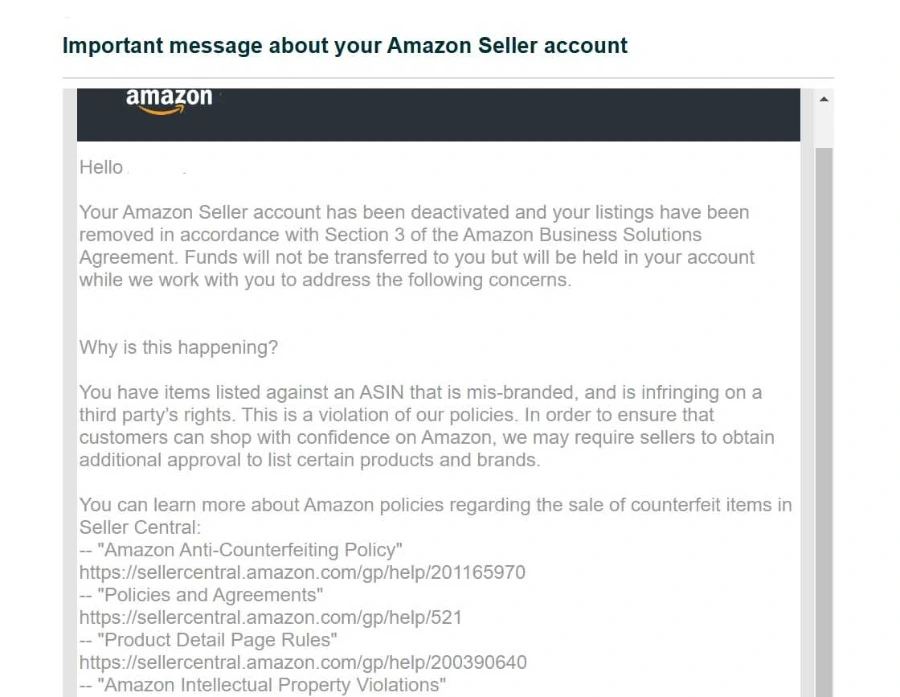
When it comes to Appeals & Templates, sellers frequently underestimate how much documentation Amazon expects before a case is even reviewed. Reviewers typically look for a clear root-cause explanation, supporting evidence such as invoices or shipping records, and a forward-looking plan that shows the same issue will not recur. Getting a second pair of eyes on the draft before submission catches gaps that are easy to miss after reading a notice repeatedly.
Many sellers reach out about Appeals & Templates only after their first attempt has already been rejected, which makes the second attempt far more important to get right. Account health metrics from the 60 to 90 days before the issue are usually part of the picture reviewers consider, even if they are not mentioned explicitly in the notice. Ultimately, the goal is to give the reviewer enough verified detail that no follow-up questions are needed.