Amazon Seller Account Violations — Every Suspension Type, Explained
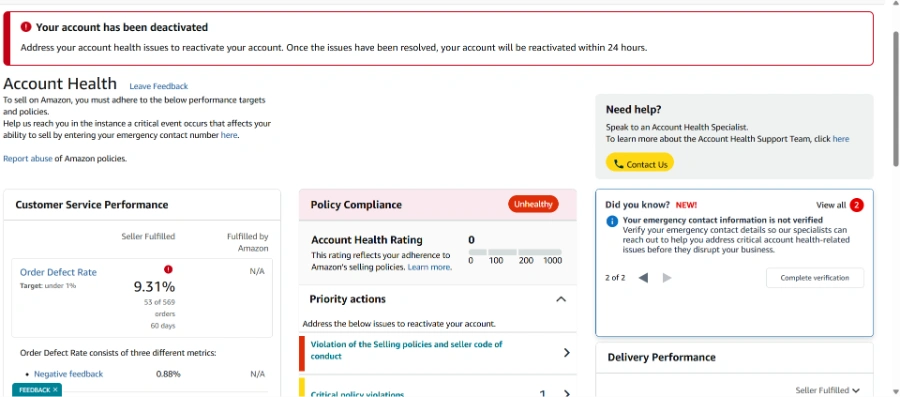
Amazon suspends seller accounts under six main enforcement categories: Section 3 of the Business Solutions Agreement, related or linked accounts, inauthentic and counterfeit complaints, intellectual property complaints, SIV/KYC verification failures, and dropshipping violations. Each has a different root cause and requires a different appeal.
If you’re asking “my amazon seller account is suspended, what do I do now?” — start by identifying which of these six categories your notice actually falls under. That single step determines everything about how the appeal should be written.
The category matters more than most sellers realise. An appeal that treats a related-accounts flag like an authenticity complaint will fail — not because it is badly written, but because it answers a question Amazon did not ask.
Below is every enforcement type we handle, what actually triggers it, and what a working appeal has to prove.
How Amazon Decides Which Violation You Have Committed
In 2026, the first flag almost always comes from an automated system, not a person. Your account is deactivated within minutes. A human usually only reviews your case once you appeal.
This creates the most misunderstood dynamic in Amazon enforcement: the system that suspended you and the person reading your defence are not the same thing. A template appeal speaks to neither.
It also explains why notices read as vague. The notice is generated from a policy category, not from a description of what you did. Your job in an appeal is to work backwards from the category to the actual trigger — and that is the part most sellers, and most appeal services, skip.
Section 3 Deactivations
Section 3 of Amazon’s Business Solutions Agreement is the broadest enforcement clause Amazon has. It lets Amazon suspend an account for conduct it judges to create risk — which is why so many unrelated triggers arrive under the same heading.
A Section 3 notice tells you almost nothing on its own. The work is diagnostic: identifying which underlying behaviour Amazon’s system actually flagged before writing a word of the appeal.
Read the full Section 3 suspension guide
Related & Linked Account Suspensions
Amazon links accounts through shared signals: IP address, device fingerprint, banking details, business identity, and address data. If it associates your account with another that was previously enforced against, yours can be deactivated regardless of whether you knew the other account existed.
This is the enforcement type where honest sellers are caught most often — shared office internet, a family member’s account, a reused bank account, a VA who worked for another seller.
Being clear about our position: the appeal here is to demonstrate the true relationship between the accounts and address it accurately. It is not to help you separate accounts to avoid detection. That is circumvention, it fails, and it turns a recoverable suspension into a permanent ban.
Read the full related accounts guide
Inauthentic & Counterfeit Complaints
An inauthentic complaint is a supply-chain evidence problem, not an opinion about your product. Amazon is asking you to prove where the goods came from. The appeal stands or falls on invoices that match the ASIN, the quantities, and the timeframe under review.
We will not create, alter, or “improve” invoices, and we will not work with suppliers who provide documents that cannot be verified. Amazon verifies with suppliers directly. Fabricated documentation is how a suspension becomes permanent.
Read the full inauthentic and IP guide
Intellectual Property Complaints
IP complaints come from rights owners, not from Amazon — which means the fastest resolution is often a retraction from the complainant rather than an appeal to Amazon.
Three distinct types, three different strategies: trademark, copyright, and patent (including registered design). Treating them the same is the most common error we see.
Read the full IP complaint guide
Intellectual Property Complaints
IP complaints come from rights owners, not from Amazon — which means the fastest resolution is often a retraction from the complainant rather than an appeal to Amazon. Trademark, copyright, and patent complaints each need a different strategy.
Read the full IP complaints guide
SIV & KYC Verification Failures
A verification failure is a documentation problem with a narrow definition of “correct.” Amazon’s systems check documents against strict formatting, recency, and consistency rules. A genuine utility bill fails if it is too old or the name format does not match your registration exactly.
Most SIV/KYC rejections are not accusations of fraud. They are mismatches. But repeated failed submissions harden the case against you, so the second attempt matters far more than the first.
Read the full SIV and KYC verification guide
Dropshipping Violations
Amazon’s dropshipping policy does not ban dropshipping — it bans being invisible as the seller of record. Enforcement almost always traces to third-party packaging, invoices, or documentation arriving with your customer’s order.
Read the full dropshipping violation guide
Every Violation Has a Second Problem: Your Money
Whatever suspended your account is also holding your funds — and that is a separate fight.
Reinstatement does not automatically release a reserve. A funds complaint does not automatically restore your listings. Since October 2024, the policy has been called the Funds Disbursement Eligibility Policy, and the post-deactivation appeal window was shortened from 90 days to 60.
That shortened window is the reason funds get lost. Sellers spend the first 60 days fighting the reinstatement and only look at the money afterwards — by which point the window has closed.
Amazon funds disbursement: how to get held funds released
Frequently Asked Questions
How do I know which violation type I have been suspended for?
Your Performance Notification names a policy. But the named policy is a category, not a diagnosis — Section 3 in particular covers dozens of underlying triggers. Send us the notice and we will tell you what we think actually fired.
Can I be suspended for more than one violation at once?
Yes, and it is common. A related-accounts flag frequently arrives alongside an authenticity complaint. Appeals that address only one will fail.
Does the violation type change how long reinstatement takes?
Yes, considerably. Verification issues can resolve quickly once the correct documents are submitted. Related-accounts cases are typically the slowest.
My appeal was rejected. Does that mean the violation type was wrong?
Often, yes. Repeated rejections almost always mean the root cause was never addressed — the appeal fixed the wording, not the trigger.
Send Us Your Notice
We will tell you which enforcement type you are actually facing, and what we would do next. No charge, no obligation, and an honest answer if we think your case is not winnable.
See these in practice: real reinstatement case studies — what the notice said, what actually triggered it, and why the obvious appeal fails.