
ASIN Suspension vs Account Suspension: What’s the Difference?
Not every enforcement action takes down your whole account. Amazon can suspend, deactivate, or remove a single ASIN (listing) while your account stays active — and the fix looks completely different from a full account suspension.
How to Tell Which One You Have
- ASIN suspension: You can still log into Seller Central, other listings are live, only one product (or a small group) is removed or flagged
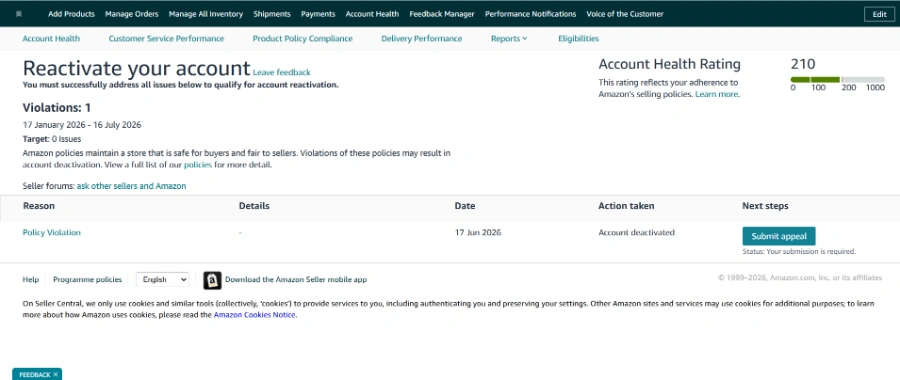
- Account suspension: Your entire selling privileges are disabled — no listings are live, and Seller Central shows an account-level notice
Check the notice itself: an ASIN-level notice references a specific ASIN or SKU. An account-level notice references your account or seller ID.
Common Reasons for ASIN-Level Suspension
- Inauthentic item complaint on that specific product
- IP complaint (trademark, copyright, or patent) tied to that listing
- Product safety or compliance complaint
- Listing policy violation (restricted keywords, prohibited claims, category restrictions)
- Pricing or MAP violation flagged by the brand owner
Why ASIN Suspensions Still Need to Be Taken Seriously
A single ASIN suspension feels less urgent than losing your whole account — but repeated ASIN-level violations feed directly into your Account Health Rating. Enough of them, left unresolved, can trigger a full account deactivation. Treating each one with a proper Plan of Action, not just letting the listing sit removed, protects your account long-term.
How to Appeal an ASIN Suspension
- Identify the exact complaint type from the notice (inauthentic, IP, safety, listing policy)
- Gather the specific evidence that complaint type requires — invoices for inauthentic, a retraction or license for IP, compliance documents for safety
- Submit through the listing-level appeal path in Seller Central, not the account-level appeal form
- Track the ASIN’s status separately — a resolved ASIN suspension doesn’t always show as “resolved” account-wide
See our full guide on IP complaints and Plans of Action →
Sellers dealing with ASIN Suspension vs Account Suspension: What’s the Difference? for the first time often underestimate how specific Amazon’s reviewers expect the response to be.
Screenshots and dated records carry more weight than a written summary alone, since they let a reviewer verify the facts directly.
Every case is judged on its own facts, so use this as a framework rather than a script to copy directly.
Sellers dealing with ASIN Suspension vs Account Suspension: What’s the Difference? for the first time often underestimate how specific Amazon’s reviewers expect the response to be.
Screenshots and dated records carry more weight than a written summary alone, since they let a reviewer verify the facts directly.
Every case is judged on its own facts, so use this as a framework rather than a script to copy directly.
The way Amazon handles ASIN Suspension vs Account Suspension: What’s the Difference? has shifted over the past few review cycles, and older forum advice can now be misleading. Sellers who organize their evidence into labeled sections — background, cause, correction, prevention — make it easier for a reviewer to confirm compliance without follow-up questions. Every account’s history is different, so treat general guidance as a starting point rather than a guaranteed template.
When it comes to ASIN Suspension vs Account Suspension: What’s the Difference?, sellers frequently underestimate how much documentation Amazon expects before a case is even reviewed. Reviewers typically look for a clear root-cause explanation, supporting evidence such as invoices or shipping records, and a forward-looking plan that shows the same issue will not recur. Getting a second pair of eyes on the draft before submission catches gaps that are ea
ASIN Suspension vs Account Suspension: Which Appeal Path Applies
The appeal path depends on which level was actioned. A listing-level notice is appealed through the listing appeal path, while an account-level notice needs a full plan of action for the account.
Do not mix the two. Submitting an account-level plan of action for a listing-level notice wastes time, and appealing a listing when the account is suspended will not restore selling privileges.
Frequently Asked Questions
Can I still sell other products if one ASIN is suspended?
Yes. A listing-level action affects only that product (or a small group). Other listings stay live, and you can still log into Seller Central. The suspended ASIN needs its own appeal.
Does an ASIN suspension affect my account health?
It can. Repeated listing-level actions can lower your account health rating and, if they accumulate, lead to an account-level action. Treat each ASIN suspension seriously, even when other products still sell.
How do I know which type of suspension I have?
Check the notice. A listing-level notice references a specific ASIN or SKU. An account-level notice says your selling privileges are disabled. The notice also tells you which appeal path to use.
Related reading: see the frequently asked questions and get a free case review for more on ASIN suspension vs account suspension.
For the official rules, see Amazon Seller Central.
Many sellers reach out about ASIN Suspension vs Account Suspension: What’s the Difference? only after their first attempt has already been rejected, which makes the second attempt far more important to get right. Account health metrics from the 60 to 90 days before the issue are usually part of the picture reviewers consider, even if they are not mentioned explicitly in the notice. Ultimately, the goal is to give the reviewer enough verified detail that no follow-up questions are needed.
A well-prepared response to ASIN Suspension vs Account Suspension: What’s the Difference? issues usually shares a few traits: it is specific, dated, and tied directly to the policy language cited. Cases that reference the exact policy clause, include dated screenshots, and avoid vague language about ‘improving processes’ are processed noticeably faster in most reported experiences. If the case involves multiple linked issues, it is usually worth addressing them together rather than filing separate appeals.